Home/Bats
Bat Removal in Roanoke
Bats are the most legally constrained animal in this trade. Getting the timing wrong is not just inhumane, it is often illegal.
Virginia bats are a harder legal problem than most people expect, because several of the species that hibernate in this region have been hit hard by white-nose syndrome and now carry protected status on top of the general rules. That matters for timing and for who may do the work: Virginia requires bat-specific training on the commercial permit, which is not something a general pest company holds.
Bats in Roanoke County: who does what
The City of Roanoke states that its Animal Wardens do not handle wild animals unless the animal is a direct threat to public safety, and refers residents to a licensed trapper or a removal service. It also gives the state wildlife conflict helpline on 855-571-9003. That helpline is advice, not a visit; nobody from it is coming to your attic.
Virginia Department of Health figures for the locality it labels “Roanoke” show 21 animals testing positive for rabies in 2025 (provisional): 10 skunks, 6 raccoons, 3 foxes, a bat and a cat. In 2024 it was 18, and 13 of those were skunks. The table has no separate Roanoke County row.
For identifying an animal or damage before anyone is paid to look, the Virginia Cooperative Extension, Roanoke County / Roanoke and Salem office is at 3738 Brambleton Avenue SW, Roanoke, VA 24018, (540) 772-7524 (office page).
What Virginia law says about bats
Seventeen bat species have been recorded in Virginia: the gray, Indiana and Virginia big-eared bats are federally endangered, the northern long-eared bat federally threatened, and three more state endangered. It is illegal to transport a bat, so one may only be released on the property where it was caught, and poisoning bats is illegal. All Virginia rules →
Maternity season (exclusion restricted): reported as roughly May 15 – August 15
Sources: Virginia Department of Health, 2025 animal rabies positives; Virginia DWR: nuisance bats; City of Roanoke, help with wild animals. Checked October 2026.
Signs, and why they matter
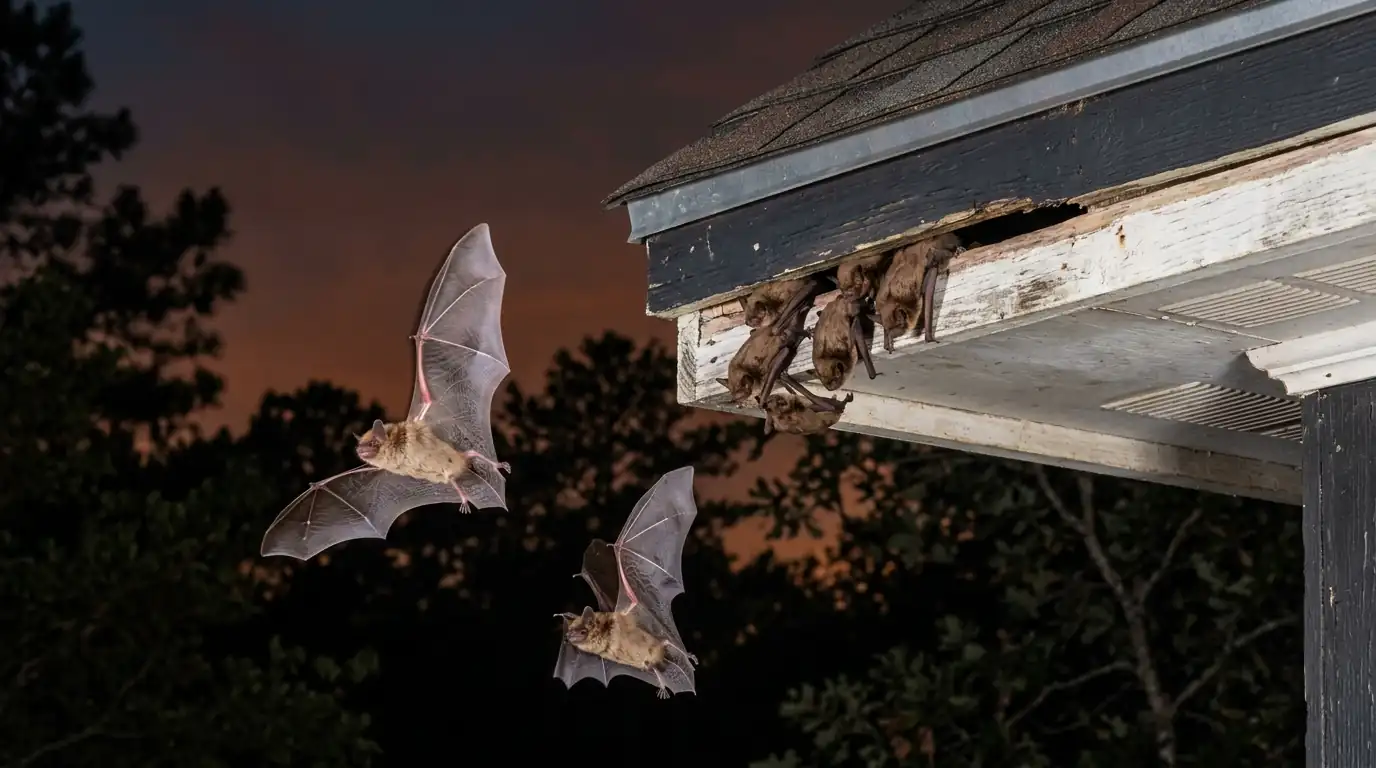
- Bats seen leaving the roofline, a gable end or a chimney around sunset
- Squeaking or rustling from a wall cavity or attic, worst on hot evenings
- A sharp ammonia smell: accumulated guano and urine
- Rabies: any direct contact, or a bat found in a room where someone was asleep, needs a call to your health department
- Histoplasmosis, a lung infection from fungal spores in accumulated guano
How removal works
Bats are never trapped or killed. A licensed operator fits one-way valves at the active exits so bats can leave but cannot re-enter, seals every other gap first, then removes the valves once the roost is empty. Guano removal and attic decontamination usually follow.
Bat questions
How much does bat removal cost in Roanoke?
$400 – $600 small colony · $500 – $1,200 typical · $5,000 – $8,500 for a large colony, depending on access and whether young are present. After a long stay in an attic the cleanup is often the bigger bill (attic restoration).
Is there a wrong time of year to deal with bats?
Exclusion is restricted during maternity season, when pups cannot yet fly. Sealing a roost then traps them inside to die. The dates differ by state: see the Virginia law page.
Who handles bats in Roanoke County?
Virginia Department of Health figures for the locality it labels “Roanoke” show 21 animals testing positive for rabies in 2025 (provisional): 10 skunks, 6 raccoons, 3 foxes, a bat and a cat. In 2024 it was 18, and 13 of those were skunks. The table has no separate Roanoke County row.
Request a quote
We read every request and pass it to a licensed wildlife operator covering Roanoke where one is available. We are still building our list of operators here, so we cannot promise one is available or say how quickly they will respond.