Home/Groundhogs
Groundhog Removal in Roanoke
The animal eats your garden. The burrow is what damages your house.
This is genuinely groundhog country, and the season runs backwards from what people assume. They hibernate properly here, emerging lean and hungry in late winter, and the burrow they come back to is usually the one they used last year. If a burrow under your shed, deck or retaining wall went quiet in November, it is not gone; it is occupied and asleep, and it will be active again in February.
Groundhogs in Roanoke County: who does what
The City of Roanoke states that its Animal Wardens do not handle wild animals unless the animal is a direct threat to public safety, and refers residents to a licensed trapper or a removal service. It also gives the state wildlife conflict helpline on 855-571-9003. That helpline is advice, not a visit; nobody from it is coming to your attic.
Roanoke County code §13-5.2 bans trapping any game or furbearing animal within 50 feet of the shoulder of a primary or secondary highway without the landowner’s written permission.
Inside the City of Roanoke, discharging a firearm is unlawful (§21-36), and so is firing an air gun except at an approved range or on private property with the owner’s permission when nothing crosses the property line (§21-37).
For identifying an animal or damage before anyone is paid to look, the Virginia Cooperative Extension, Roanoke County / Roanoke and Salem office is at 3738 Brambleton Avenue SW, Roanoke, VA 24018, (540) 772-7524 (office page).
What Virginia law says about groundhogs
Virginia regulation designates the woodchuck (groundhog) a nuisance species: DWR lists a continuous open season and no kill permit is required. Relocating a trapped groundhog to another area is still illegal. All Virginia rules →
Sources: Virginia DWR, local ordinances: Roanoke County; Virginia DWR, local ordinances: City of Roanoke; 4VAC15-20-160, nuisance species designated; Virginia DWR: groundhogs; Virginia DWR: nuisance wildlife; City of Roanoke, help with wild animals. Checked October 2026.
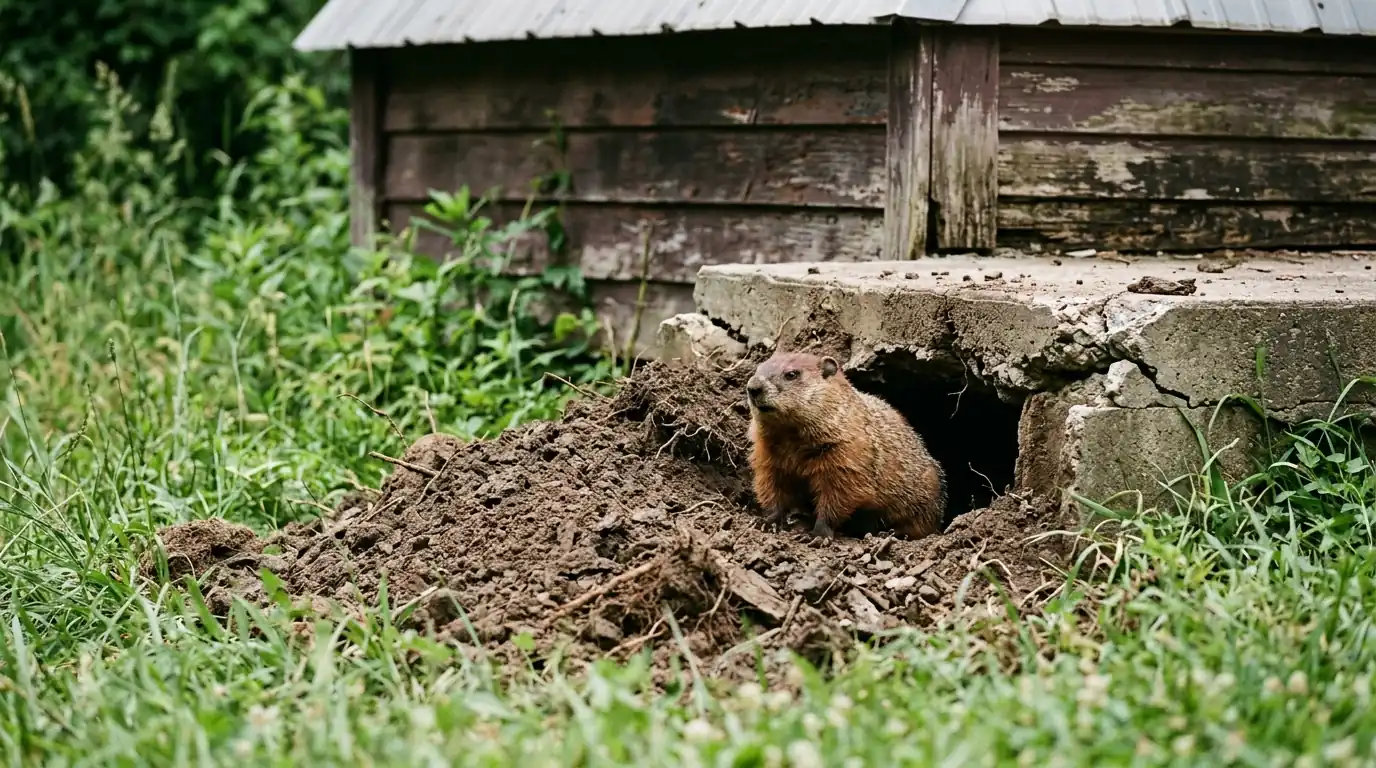
Signs, and why they matter
- A burrow entrance 10–12 inches across with a mound of excavated soil beside it
- Multiple secondary entrances, often hidden in shrubs or against a wall
- Cropped garden plants and gnawed bark on young trees
- Tunnels running under foundations, slabs, decks and retaining walls
- Undermined footings and settling that becomes a structural repair
How removal works
Trapping and removal, then collapsing and backfilling the burrow system and fitting a dug-in barrier. Leaving the tunnels open invites the next occupant.
Groundhog questions
How much does groundhog removal cost in Roanoke?
$250 – $500 typical, depending on access and whether young are present. After a long stay in an attic the cleanup is often the bigger bill (attic restoration).
Is there a wrong time of year to deal with groundhogs?
Most active spring through autumn; they hibernate over winter, which is when the burrow can safely be closed for good.
Who handles groundhogs in Roanoke County?
Roanoke County code §13-5.2 bans trapping any game or furbearing animal within 50 feet of the shoulder of a primary or secondary highway without the landowner’s written permission.
Request a quote
We read every request and pass it to a licensed wildlife operator covering Roanoke where one is available. We are still building our list of operators here, so we cannot promise one is available or say how quickly they will respond.