Home/Raccoons
Raccoon Removal in Roanoke
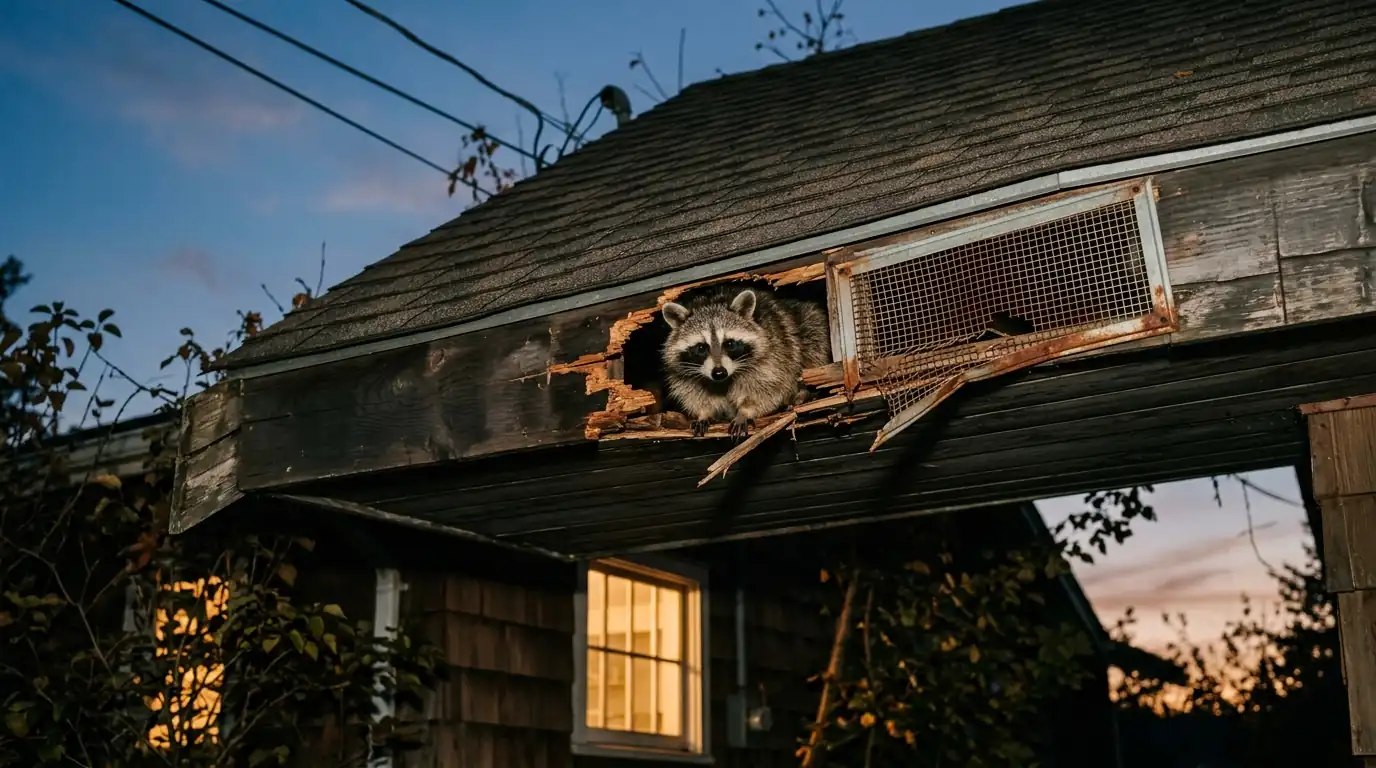
Raccoons tear their own way in, which is why they do more damage to a house than most animals that get inside one.
Winter is the pattern here in a way it is not further south. A female looking for a natal den in late winter wants somewhere dry, insulated and defensible, and a Roanoke attic beats a hollow tree on a north-facing slope every time. If you are hearing something heavy overhead in January or February, assume it is looking for somewhere to have young rather than just passing through.
Raccoons in Roanoke County: who does what
The City of Roanoke states that its Animal Wardens do not handle wild animals unless the animal is a direct threat to public safety, and refers residents to a licensed trapper or a removal service. It also gives the state wildlife conflict helpline on 855-571-9003. That helpline is advice, not a visit; nobody from it is coming to your attic.
Virginia Department of Health figures for the locality it labels “Roanoke” show 21 animals testing positive for rabies in 2025 (provisional): 10 skunks, 6 raccoons, 3 foxes, a bat and a cat. In 2024 it was 18, and 13 of those were skunks. The table has no separate Roanoke County row.
Roanoke County code §13-5.2 bans trapping any game or furbearing animal within 50 feet of the shoulder of a primary or secondary highway without the landowner’s written permission.
For identifying an animal or damage before anyone is paid to look, the Virginia Cooperative Extension, Roanoke County / Roanoke and Salem office is at 3738 Brambleton Avenue SW, Roanoke, VA 24018, (540) 772-7524 (office page).
What Virginia law says about raccoons
Virginia law makes the raccoon both a game animal and a fur-bearer. A landowner may trap or shoot one on their own land in the closed season when it is damaging property or threatening health or safety, with no kill permit, and DWR lists Roanoke County among the localities with a continuous open trapping season for raccoons. What a homeowner may not do is relocate it: DWR says trapping an animal and moving it to another area is illegal in Virginia. All Virginia rules →
Sources: Virginia Department of Health, 2025 animal rabies positives; Virginia DWR, local ordinances: Roanoke County; Code of Virginia §29.1-100; Code of Virginia §29.1-517; Virginia DWR: raccoons; Virginia DWR: nuisance wildlife; City of Roanoke, help with wild animals. Checked October 2026.
Signs, and why they matter
- Heavy, deliberate footsteps overhead: raccoons are big enough to sound like a person walking
- Chittering, growling or the distinctive cry of kits, usually at dusk or just before dawn
- A torn soffit, lifted shingles, or a ripped roof or gable vent
- Rabies: raccoons are a primary rabies vector across the southeastern United States
- Raccoon roundworm (Baylisascaris) in the droppings, which is dangerous to people and pets
How removal works
A licensed operator finds every entry point, removes the animal, and critically any kits, which are usually hidden in a wall cavity or soffit and cannot leave on their own, then seals the openings with materials a raccoon cannot tear off. Sealing before the young are out is the most common and most expensive mistake.
Raccoon questions
How much does raccoon removal cost in Roanoke?
$300 – $600 for removal; far more if the attic needs restoring, depending on access and whether young are present. After a long stay in an attic the cleanup is often the bigger bill (attic restoration).
Is there a wrong time of year to deal with raccoons?
Spring is the worst time to trap and seal: females den in attics to give birth, and removing the mother while kits remain leaves them to die inside the structure.
Who handles raccoons in Roanoke County?
Virginia Department of Health figures for the locality it labels “Roanoke” show 21 animals testing positive for rabies in 2025 (provisional): 10 skunks, 6 raccoons, 3 foxes, a bat and a cat. In 2024 it was 18, and 13 of those were skunks. The table has no separate Roanoke County row.
Request a quote
We read every request and pass it to a licensed wildlife operator covering Roanoke where one is available. We are still building our list of operators here, so we cannot promise one is available or say how quickly they will respond.